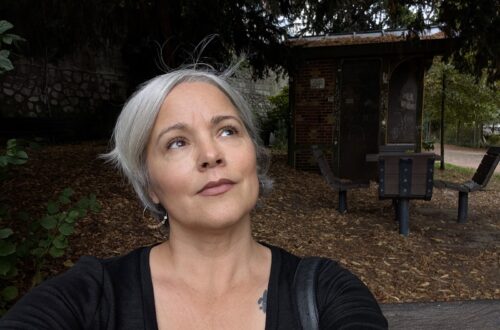
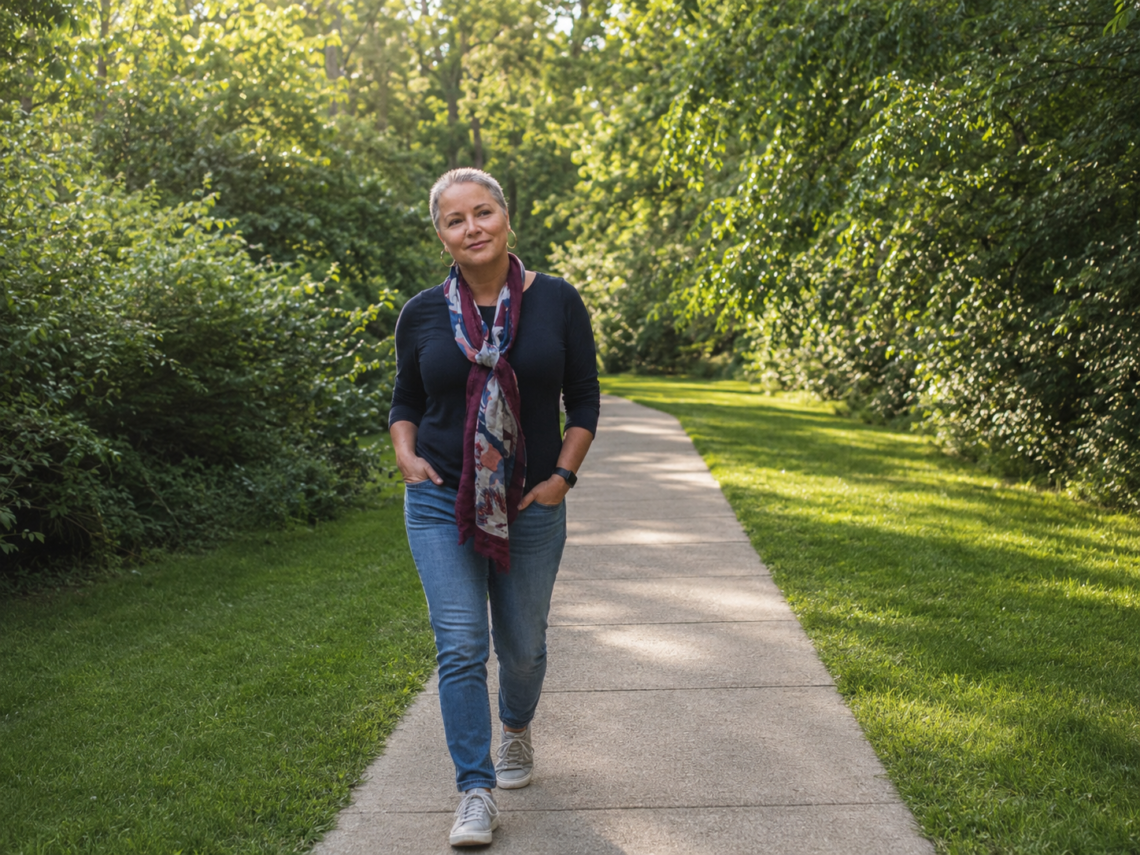
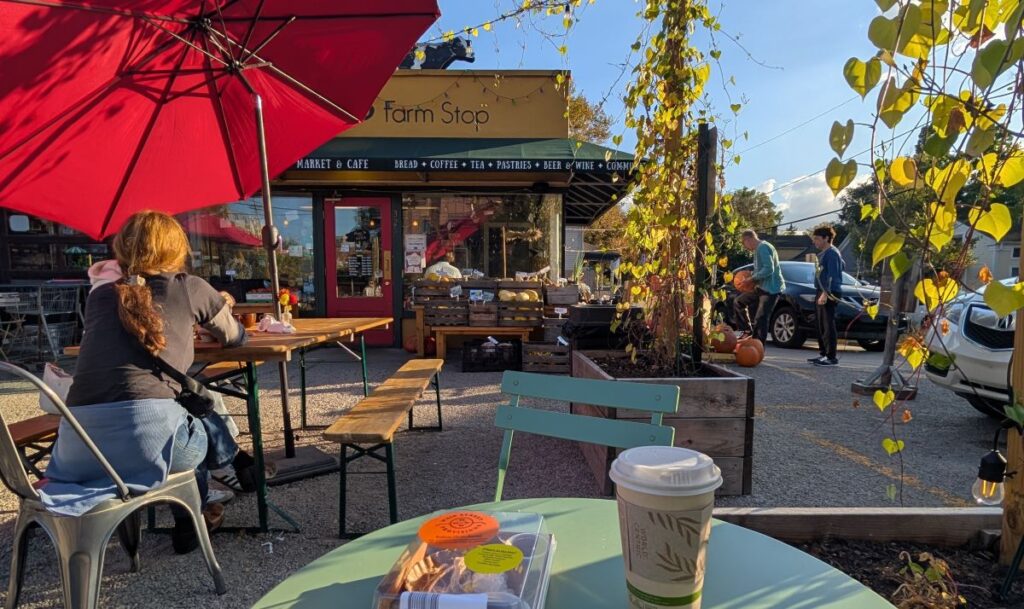
It’s a stunning Saturday morning here in my own version of paradise. I’m sitting at a picnic table outside Argus Farm Stop, enjoying an iced coffee and a gluten-free pastry while thinking about walking after 50—and why this simple practice has become so essential to both my physical and spiritual well-being.
I almost didn’t come.
I’d stayed up late last night drinking wine and reading a good book, so I slept until nearly nine this morning. When I finally woke, I considered skipping my usual two-mile Saturday walk to Argus. It would’ve been easy to linger in bed, make coffee at home, and tell myself I’d walk later.
But it’s never really been about Argus. It’s about the walk.
I’ve never regretted getting up and going for a walk, where I inevitably encounter countless tiny miracles. But I’ve often regretted the walks I didn’t take.
When the Quiet Voices Can Be Heard
Walking is exercise for me, of course, but it has always been so much more than that.
In the silence of my morning or evening walks, my intuition talks to me. Sometimes, it feels as though the Universe talks to me, too.
My eyes are occupied by beautiful scenery. My feet are busy navigating uneven sidewalks and stepping over ants. My ears are soothed by soft music whispering to my soul through my earbuds. My mind becomes less consumed by work, bills, responsibilities, and all the problems I haven’t yet figured out how to solve.
The steady motion settles whatever is restless and anxious within me. It creates a little more space between my thoughts.
And in that space, the quieter voices—the ones so easily drowned out by the chaos of daily life—can finally be heard.
When I look back now, I can see that walking has accompanied me through nearly every version of my life. At first, it was an escape, a way to leave behind the noise and conflict of my childhood home. Later, it became a place of companionship, where dreams and ordinary days were shared with someone walking beside me. Then, for nearly a decade, it became something I lost as motherhood, ambition, heartbreak, and survival consumed the space it once occupied.
Eventually, walking became the path that led me back to myself.
Walking to Find Peace
I’ve always been a walker.
When I was a child living in a small three-bedroom house in the bush of Northern Ontario, I walked to get away from a home occupied by my parents, my three siblings, and all the noise that came with us.
I walked to escape the arguments, the fighting, and the claustrophobic lack of space. I walked to find meaning in my life and to feel the joy I seemed able to access most easily in nature. I walked to talk to God.
Even in the pitch-black darkness of my nighttime walks along those rural roads, I found peace.
There was something about moving through the dark beneath an open sky that allowed me to breathe more deeply. The house, with all its tension and limitations, fell behind me. The road stretched forward, and for a little while, I felt free.
The Years of Walking Together
Before we had our son, my ex-husband and I used to walk for miles with our husky, Shadow, in the cool evenings.
We talked about our dreams and plans, our days, and our relationship. There was something easy about talking while walking side by side. We didn’t have to stare directly at one another or force a conversation. The words simply unfolded alongside the road.
When I became pregnant, I kept walking, although those long outings became a little more complicated. My bladder apparently had no intention of cooperating with our one- or two-hour walks through the city I loved, so I occasionally had to find a discreet place to pee in the woods.
Then our son was born, and life unfolded quickly.
For nearly ten years, I stopped walking.
I became consumed with motherhood and with working toward my PhD. Every part of me seemed directed toward caring for my son, managing our home, and trying to accomplish a goal that had become tangled up with my sense of identity and worth.
Then my marriage fell apart, and eventually, so did my PhD.
I spiralled downward into my Dark Night of the Soul and spent a long time falling apart while still trying to hold everything together for my son and me.
Walking, once such a natural part of my life, disappeared somewhere along the way. I didn’t yet understand how much of myself had disappeared with it.
Remembering What I Loved
After my Dark Night, when I began the slow work of rebuilding my life, I got a puppy for my son.
That puppy had me outside at five or six in the morning for walks. I resented those early mornings for a while. I was perpetually exhausted, and the last thing I wanted was to leave my warm bed and wander through the cold and darkness before dawn.
But then I began to notice things.
Rabbits chased and leapt over one another in the grass. Dew sparkled like diamonds. The rising sun stretched gold and pink across the morning sky with such aching beauty that I sometimes had to stop walking just to take it in.
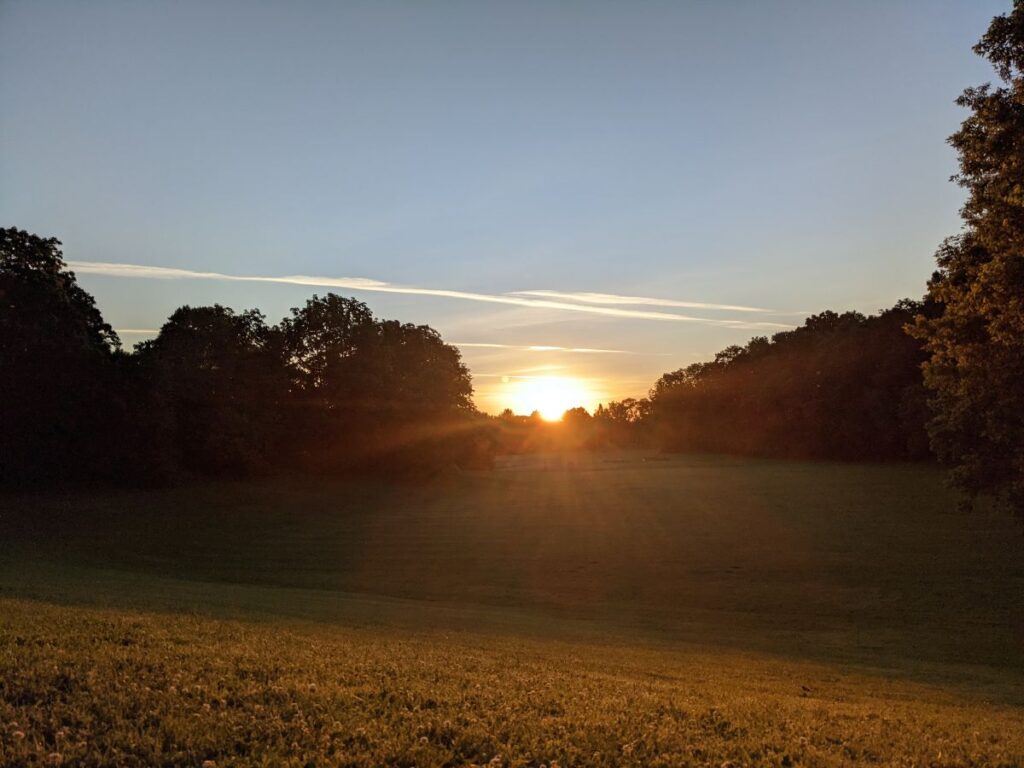
With every small miracle, I began remembering how much I loved to walk.
I remembered how much I loved witnessing the world wake up. I loved seeing the days and seasons unfold, almost imperceptibly, with each early-morning adventure. I noticed the first buds opening in spring, the thickening green of summer, the first cool shift in the autumn air, and the silence that arrived with snow.
Walking reintroduced me to the world.
In time, it also began reintroducing me to myself.
The Things I Learned on the Road
As my healing unfolded, I began to notice that certain knowings came to me during those long walks.
My intuition started having conversations with me that I’d never been quiet enough to hear before. Messages entered my consciousness from an intelligence that sometimes seemed separate from my own.
I know I’ve written before about one of the most memorable examples.
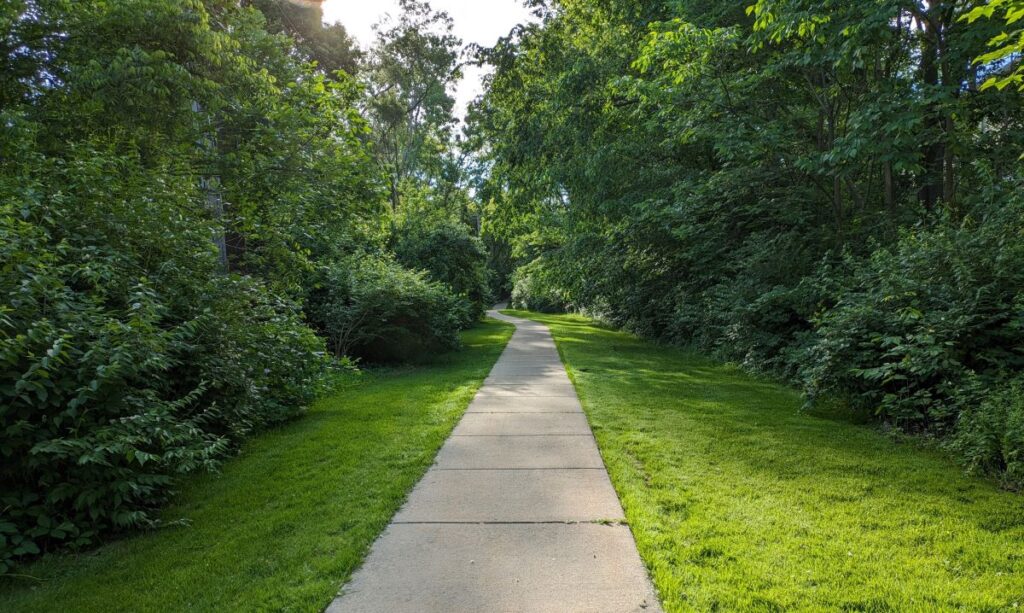
It happened four or five years ago, just after dawn, while I was walking along a quiet path through my neighborhood. I was thinking about my spiritual journey and wondering why my efforts to manifest certain things in my life seemed to be coming to nothing.
I was impatient. I had worked hard. I had healed so much. I had become very clear about what I wanted, and I couldn’t understand why it wasn’t arriving according to my preferred timeline.
Then, with a clarity that didn’t match the rambling nature of my usual thoughts, three words arose in my consciousness:
They felt spoken rather than thought.
I’d like to say I understood the lesson immediately and changed my life right there on that path. In reality, it would take nearly four more years for me to truly learn how to trust and surrender.
Still, I worked at it because I knew the message mattered. I knew this was a lesson placed on my particular docket to learn.
It wasn’t that I didn’t understand the concept. It was my own stubborn resistance to relinquishing control that kept me from living it.
I wanted to control the why, the how, and especially the when.
Now that I’ve finally begun to let go of that need, my days are filled with far more ease. I no longer believe that everything depends on my ability to force, manage, predict, or prevent every possible outcome.
Even the years it took me to learn the lesson weren’t wasted. During that time, I learned other things that made trust a little easier and surrender a little less frightening.
Perhaps that’s how the deepest lessons are learned. Not all at once, but gradually, as life prepares us to understand what we were once only capable of hearing.
Returning to Myself
Looking back, I can see that my relationship with walking has mirrored my relationship with myself.
As a child, I walked to escape a life in which I felt crowded and unsettled. Later, I walked beside someone else, sharing dreams and imagining the life ahead of us. Then, during the years when I became consumed by motherhood, achievement, heartbreak, and survival, I stopped walking—and, in many ways, lost touch with myself as well.
When I finally returned to walking, I began returning to myself.
Step by step, I rediscovered the parts of me that had been buried beneath exhaustion and responsibility: my wonder, my intuition, my spirituality, and my ability to feel at peace in my own company.
The walking didn’t heal me all by itself. Like meditation and the other practices that have supported my healing, it created the quiet in which I could begin to hear what needed healing. It gave my body somewhere to place its restless energy and my soul enough space to speak.
Walking After 50: An Act of Love for Body and Soul
I think this is part of what makes walking after 50 feel so meaningful. At this stage of life, I’m no longer walking simply to escape, arrive somewhere, or burn calories. I’m walking because it helps me remain connected to the person I’ve worked so hard to rediscover.
There are countless benefits to walking.
Movement shakes loose the stress and anxiety that become stuck in the body. Beautiful scenery lends fresh perspective to old views and outdated beliefs that no longer hold truth. Fresh air brings clarity to shapeless ideas and reveals solutions that seemed hidden while we were sitting still.
Even the simple act of covering distance carries its own quiet symbolism. One step may not seem significant, but enough steps will take us somewhere entirely new.
Healing often works that way, too.
We rarely transform our lives through one dramatic action. More often, we change through small, steady acts of care repeated over time. We take the walk. We notice the sunrise. We listen for the quiet voice. We place one foot in front of the other, even when we can’t yet see where the path is leading.
That’s what walking has become for me.
It’s an act of love for both my body and my soul.
And so, here I am, grateful that I got myself out of bed and took the walk that brought me to this picnic table.
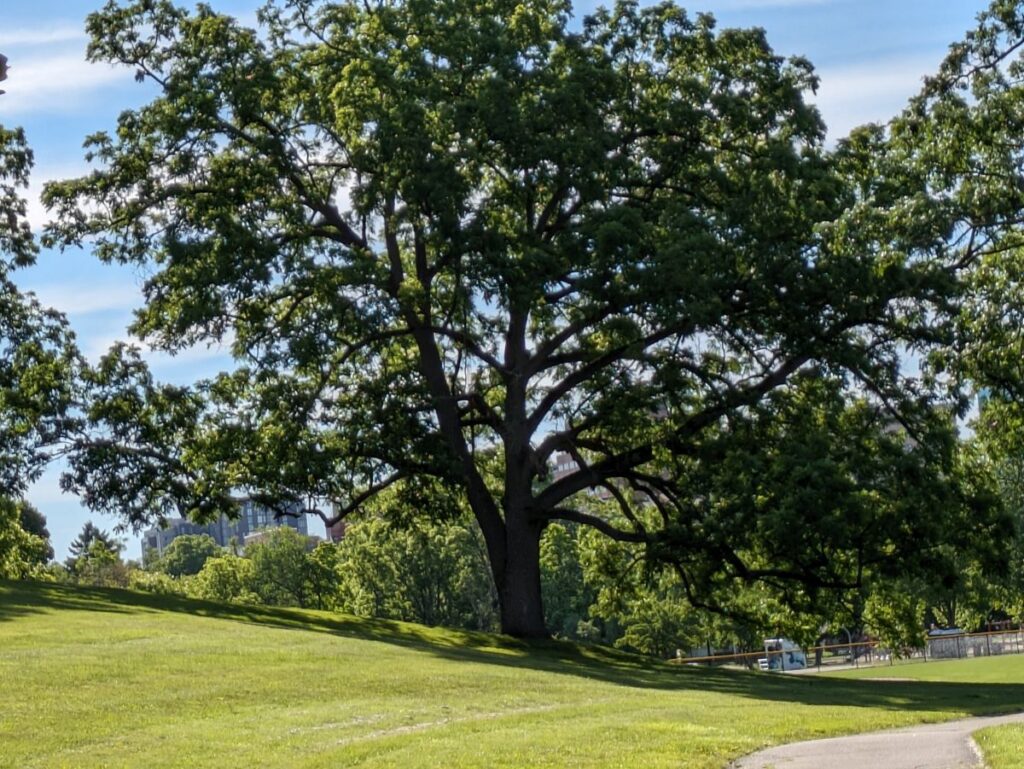
On my way home, I’ll swing through West Park and sit beneath my favourite tree for an hour-long meditation. It’ll probably be noon by the time I eventually make it home.
The morning will be mostly gone, but it won’t feel wasted.
I’ll feel deeply satisfied that I got up, stepped outside, and made the most of this beautiful Saturday morning.
And somewhere between here and home, perhaps I’ll grow quiet enough to hear even more of what my soul has been trying to say.