A funny thing happened while I was preparing for my upcoming six-week trip to France.
I was trying on clothes.
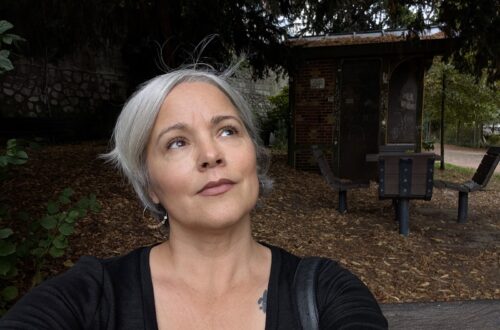
Nothing particularly profound was supposed to come from it. I’ve been putting together a travel capsule wardrobe, and because I wanted to see how different pieces actually worked together, I started taking photos of myself in various outfits.
I expected the photos to help me decide what to pack.
Instead, they messed with my head a little.
Because the woman I saw in the photographs wasn’t always the woman I thought I’d been seeing in the mirror.
Some of the outfits I was convinced looked good on me really didn’t. Long, loose cardigans swallowed me. Untucked shirts sometimes made me look wider and more shapeless than I realized. Certain tops that seemed perfectly fine when I stood in front of the mirror looked completely different in a photograph.
Meanwhile, some of the things I’d been reluctant to wear because I assumed they weren’t flattering with my top-heavy physique—a fitted black blazer, my cropped leather jacket, tucked-in shirts, a colorful peasant blouse—looked surprisingly good.
More structured. More intentional. More like me.

Apparently, my mirror and my camera had been telling two very different stories.
And somewhere between changing clothes and staring at photographs of myself, I realized this wasn’t really about packing for France anymore.
It was about being seen.
When Did I Decide to Disappear?
For the last several years, so much of my attention has been turned inward.
I’ve been healing. Learning to love myself. Learning to enjoy solitude. Learning who I am when nobody else is reflecting an identity back to me.
That work has changed almost everything, but lately I’ve started wondering whether, somewhere along the way, I also quietly removed myself from the world’s gaze.
Not consciously, of course. I don’t remember standing in front of my closet one morning and deciding I wanted to disappear. But perhaps invisibility served me for a while.
When I was younger, I was very aware of how I looked, and I was equally aware of being looked at. Male attention was plentiful, and although I didn’t understand it at the time, some part of me depended on that attention. Being desired reassured an unhealed young woman that she had value.
It’s exhausting to live that way because even when the attention feels good, you’re still seeing yourself partly through someone else’s eyes. You notice how you’re being received, whether you’re attractive enough, whether you’ve been noticed, and whether the room is reflecting back the version of yourself you hope to be.
Over the years, I stopped asking those questions.
And maybe, in order to stop asking them, I needed to step outside of that for a while.
Comfort, Rebellion, or Camouflage?
Of course, there may also be a much simpler explanation for some of my recent fashion choices.
I like comfortable clothes.
There. Mystery solved.
I’ve gravitated toward loose sweaters, soft fabrics, flowy shirts, and a vaguely bohemian style because I genuinely like them. I thought they suited me. When I looked in the mirror, I liked what I saw.
And some of that probably was simply experimentation. Our bodies change. Our faces change. Our hair changes. The things that looked effortless at 35 don’t necessarily work the same way at 52, and figuring out what feels like you again can take some trial and error.
But I also wonder whether there was a little rebellion mixed in.
When I turned 50, I buzzed off my dyed brown hair and let my natural gray grow in.

It was one of the most liberating things I’ve ever done.
It was also fascinating to watch how quickly the world seemed to respond. Or, more accurately, how quickly it seemed to stop responding.
Women often talk about becoming invisible as they age, and I understood what they meant almost immediately. White hair is a powerful cultural signal. Whatever vitality, sensuality, intelligence, humor, or beauty exists beneath it, the world tends to register “older woman” first.
There was a part of me that liked refusing to fight that.
I wasn’t going to dye my hair because society preferred women to pretend they weren’t aging. I wasn’t going to squeeze myself into uncomfortable clothes because a female body is apparently supposed to remain decorative at all times. I wasn’t interested in spending enormous amounts of money or energy maintaining some polished version of womanhood that had never particularly interested me in the first place.
Maybe some of my clothing choices were simply my way of saying, Fine. If you’ve decided I’m invisible anyway, I’m not going to contort myself trying to change your mind.
For a while, that felt powerful.
But lately I’ve begun to wonder whether rejecting society’s expectations around beauty somehow got tangled up with rejecting my own desire to feel beautiful.
Those aren’t the same thing.
The Strange Case of My Lying Mirror
There’s another part of this that I’m still trying to understand.
My mirror appears to have become incredibly generous.
This is particularly amusing because for most of my life, mirrors worked exactly the other way around.
I could look perfectly lovely and immediately locate the five things that were wrong with me. My stomach, my thighs, the lines around my eyes, whatever flaw happened to be receiving top billing that day.
Like so many women, I became skilled at reducing an entire human being to the handful of things she wished she could change.
But something strange has happened after years of self-love work.
Now I look in the mirror and think I look pretty damn good.
Apparently, sometimes considerably better than photographic evidence would suggest.
I found myself laughing about this recently because surely body-image distortion is supposed to work in the other direction. How did I become the woman looking in the mirror and seeing someone fifteen pounds thinner and significantly hotter than the woman appearing in the photograph?
And then I started wondering whether maybe my mirror isn’t exactly lying.
Maybe I’ve simply learned to see myself differently.
When I look in the mirror now, I’m no longer conducting an inventory of flaws. I see the whole woman. I see her expression, her energy, her white hair, her strength and softness, the life she has lived, and the woman she has become.
Perhaps self-love has softened my gaze enough that I naturally see the best in myself.
If so, I’m not sure that’s something I particularly want to correct.
I might just need better clothes.
The Woman in the Photographs
Still, those photographs gave me useful information.
There’s a difference between criticizing our bodies and learning how to dress them.
I don’t need to decide that my body is wrong simply because a particular sweater doesn’t flatter it. Maybe the sweater is wrong.
That seems ridiculously obvious, yet I’m not sure I always understood it.
When something looked bad on me in the past, I was much more likely to conclude that there was something wrong with my stomach, my hips, my arms, my height, or my weight. Now I’m beginning to look at clothing in terms of composition instead.
Proportion. Shape. Color. Texture.
It actually feels creative.
A jacket creates a line that a cardigan doesn’t. Tucking in a shirt changes my proportions. A little structure gives definition to a body that disappears under too much fabric. Color near my face brings out something that gray sometimes drains away.

Selfies by Tracy R. (8/14/2026) and edited by ChatGPT.
None of those observations require me to dislike my body.
They simply allow me to dress the body I have, and I’m discovering that I’d actually like to.
Maybe I’m Ready to Be Seen
That realization has opened a door I wasn’t expecting.
Because the truth is, I don’t want to disappear anymore. At least not all the time.
I don’t want to return to the hyperawareness of my younger years, when so much of my confidence was tangled up with whether men found me attractive. I worked too hard to free myself from that.
But there’s a wide territory between needing attention and refusing visibility.
I think I’m finally finding it.
The truth is that I’d like to be comfortable and attractive. I’d like to walk into a café wearing something that feels good on my body and also makes me feel a little fabulous. I’d like my hair, makeup, jewelry, and clothing to become another form of creative expression.
And yes, I’d like to catch the eye of a handsome man once in a while.
There. I said it.
I love my own company. I’ve built a life in which being alone no longer feels like a deficiency that needs to be corrected.
But I also don’t necessarily want to be alone forever. I’m not closing any doors.
Those things don’t contradict each other, and neither do self-love and enjoying admiration.
The difference, I think, is in where my sense of worth comes from.
Once, attention helped convince me I was worthy. Now I know I’m worthy before I ever leave the house, and that allows outside admiration to become something enjoyable rather than something I need.
Being Seen Without Losing Myself
Maybe this is simply another stage of healing.
There was a time when I needed to withdraw.
I needed to turn my gaze away from the world and toward myself. I needed to learn what remained when admiration disappeared, relationships changed, youth faded, and the old sources of validation stopped feeding me.
What remained was a version of myself I actually liked.
And perhaps that’s why I’m becoming interested in adorning her again.
Not correcting her. Not trying to make her younger. Not trying to turn her into something more acceptable.
Just expressing her.
There’s something playful about that.
A little eyeliner. A beautiful blouse. A jacket that makes me stand taller. Earrings that catch the light. White hair that I once thought might make me invisible becoming part of the very thing that makes me striking.
Maybe there’s no contradiction between my inner life and any of this.
Maybe all of that inward work wasn’t meant to make me care less about being human. Maybe it was meant to help me enjoy being human without being ruled by other people’s opinions.
I can love myself deeply and still enjoy beauty. I can reject society’s rules about aging without rejecting my own desire to feel attractive. I can be comfortable without hiding. I can enjoy being admired without depending on admiration.
And I can take up a little more visual space in the world without handing the world the power to tell me what I’m worth.
For several years, I think I needed the quiet. I needed the inward turn, and perhaps I even needed a little invisibility.
But lately something in me has been shifting.
The woman who spent years learning how to see herself is beginning to feel ready to let the world see her, too.