
Later tonight, I’ll board a plane for France to begin the six-week pilgrimage I’ve been planning for more than a year. For me, this first experience of solo travel after 50 is about much more than seeing France.
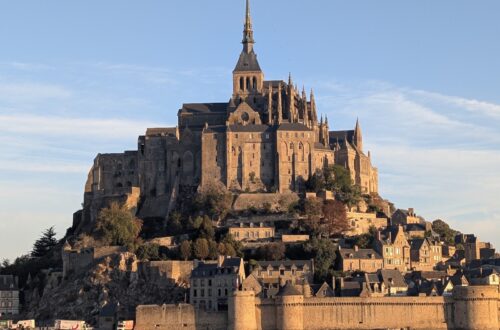
I’ll spend eleven days in Rouen, ten days in Avranches, and nearly three weeks in Blois, traveling slowly through villages, cathedrals, castles, coastlines, and places connected to my family history. I’ll walk the streets of cities older than those of us from the west can fully comprehend, spend a night on Mont Saint-Michel, and follow whatever quiet invitations arise along the way.
But this pilgrimage isn’t really about France.
It’s about the woman who is going there.
Solo Travel After 50: Learning to Travel as the Woman I Am Now
I’ve traveled extensively before. More than twenty years ago, my then-fiancé (now ex-husband) and I took six months off work and backpacked through 15 countries from Australia and New Zealand up to the Netherlands and Norway. I know how to navigate unfamiliar places, solve problems, change plans, and find my way.

But this will be my first solo international trip.
There’s a part of me that sees it as a test of my capability, although I already know I’m capable. Perhaps it’s more accurate to say that it will be an opportunity to experience that capability in a new way—not as someone’s partner, someone’s mother, or one half of a traveling pair, but entirely as myself.
I’m also not the same woman who traveled all those years ago.
As a young woman, I was deeply conscious of how I appeared to other people. I liked being noticed and found attractive, because that was one of the ways I measured my self-worth. But that attention also made me self-conscious. I worried about looking foolish, being awkward, or being judged. Even in moments of adventure, some part of me was often observing (and judging) myself from the outside.
That concern has largely fallen away.
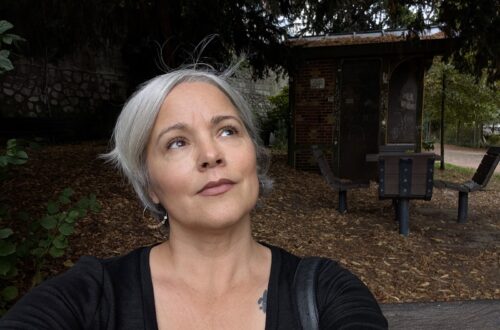
I’m no longer worried about whether strangers find me beautiful or interesting. My white hair and age sometimes make me nearly invisible to others, and, much to my surprise, I don’t mind. There’s freedom in no longer needing the world to reflect my value back to me.
I expect that freedom to change the way I travel.
I can imagine myself sitting alone at a café without feeling conspicuous, wandering wherever curiosity leads me, changing my plans without consulting anyone, and moving through the world completely comfortable in my own skin.
That will be new.
Not traveling alone, exactly, but traveling without abandoning myself.
I Was Done Waiting
A while ago, I wrote about learning to walk alone and my decision to stop waiting for a friend or partner before doing the adventurous things I wanted to do.
When I turned 50, something shifted. I realized I could no longer place my life on hold while waiting for someone else to arrive and accompany me into it.
Around the same time, my son was nearing the end of high school, and I knew my role as his caregiver was about to change dramatically. Planning this pilgrimage became a way to honor that transition—to mourn one season of motherhood while celebrating the beginning of another.
Life hasn’t unfolded exactly as I imagined when I first began planning. My son has now moved in with me full-time, and rather than leaving immediately for college, he plans to take a gap year to work and travel.
Still, the meaning of the pilgrimage hasn’t changed.
Whether my son is living at home or away at school, I’m entering a new era of my life. Motherhood remains part of who I am, but it no longer consumes the entire landscape of my identity.
This pilgrimage is a celebration of my courage and of the work I’ve done in the wake of my Dark Night to rebuild my life—and rebuild myself—into something I don’t merely tolerate, but deeply and intrinsically love.
Rising From the Ashes
There’s a freedom in my soul now that I’ve never known before, and it isn’t simply the freedom associated with becoming an empty nester.
It’s the freedom that has come through healing.
Seven years ago, I was a woman writhing in pain, despair, desperation, rage, fear, anxiety, worry, and self-hatred. Today, I’m hardly recognizable as that woman, and I’m not talking about letting my hair go white.
She rose from those ashes like a phoenix.
She didn’t rise because someone rescued her. She rose because, slowly and painfully, she learned how to rescue herself.
She faced the wounds she’d spent years avoiding. She questioned the beliefs that had kept her small. She learned to stop seeking love in places where she had to abandon herself to receive it. She discovered stillness, Spirit, self-compassion, and the deep, steady knowing that her life belonged to her.
The pilgrimage to France may look like the grand adventure, but the more difficult journey has already happened.
It was the journey home to myself.
Eyes to See the Abundance
As I write this, I’m sitting on my front deck on a gorgeous Saturday morning, just a few weeks past my 52nd birthday and seven hours from my departure.
Everything around me seems touched by grace.

I began the morning writing in my gratitude journal, and tears came as I reflected on the mystery of my journey: how the universe placed lessons, people, books, messages, and guidance before me at every step, quietly showing me the way here.
To this ease.
To this rest.
To this deep satisfaction with myself and the life I’ve created.
Nothing about my life is perfect. There are still worries, disappointments, difficult days, and practical realities to navigate. Healing hasn’t removed me from the human experience.
But it has ended the war within me.
There’s no longer a constant argument between who I am and who I think I’m supposed to be. There’s no desperate hunger to become worthy of love. There’s no longer a voice insisting that happiness exists somewhere outside of me, waiting to be granted by another person or a different life.
What remains is a sense of enoughness.
Not complacency. Not the absence of desire. Simply the knowledge that I am already whole, even as I continue to grow.
The Journey We Can No Longer Avoid
I believe this kind of healing is available to anyone who becomes willing to seek another way.
We can avoid our pain for years. We can distract ourselves, numb ourselves, overwork, over give, chase validation, remain in relationships that diminish us, or build lives that look acceptable from the outside while feeling unbearable within.
But eventually, what’s unhealed asks for our attention.
Sometimes it arrives through heartbreak. Sometimes through anxiety, exhaustion, loneliness, or the collapse of a life we thought would save us. However it comes, there’s often a moment when we realize the old ways are no longer working.
If we can find within ourselves a deep desire for something better—and if we’re willing to do the difficult, honest work required to create it—another life becomes possible.
A life with more peace.
A life with more freedom.
A life we don’t continually need to escape.
Becoming the Woman Who Adventures
As I contemplate finally leaving for this pilgrimage, I’m thrumming with excitement—not only about the places I’ll see, but about the version of myself I’m continuing to create.
I want travel, solo or otherwise, to become part of my life.
I want adventure to become part of my life.
I want courage to become part of my life—not necessarily the absence of fear, but the willingness to make meaningful choices despite it.
I began at 50 with solo camping trips. Now I’m taking the next step: a six-week odyssey through France in which I get to be the hero of my own story.
That doesn’t mean everything will go smoothly. I’ll probably get lost. I’ll misunderstand people. I’ll feel tired, lonely, overwhelmed, or uncertain at times. I may discover that some parts of solo travel are more difficult than I imagined.
But confidence isn’t the belief that nothing will go wrong.
It’s the knowledge that I won’t abandon myself when it does.
Writing Our Own Definitions After 50
I hope that sharing my experience with solo travel after 50 will offer something to other women facing changing roles and unfamiliar definitions of themselves.
At this age, the labels we’ve worn for decades may begin to loosen. Children grow. Relationships change. Careers evolve. Bodies age. The roles that once structured our days may no longer require us in the same way.
That can feel like loss.
But it can also be an invitation.
We’re allowed to create our own labels now. We’re allowed to write new definitions of who we want to be in the second half of life.
The opportunities at this age are unique and nearly endless. The wisdom earned through a lifetime of caring for and serving others can finally help us recognize that it’s time to include ourselves in that care.
Not by abandoning our responsibilities, but by refusing to keep abandoning ourselves.
In a few hours, I’ll leave for France. I plan to write while I’m there—not simply about the places I visit, but about what the journey reveals to me. I want to remain attentive to the spiritual pilgrimage beneath the practical one: the fears that surface, the freedoms I discover, and the woman who continues to emerge as I walk.
I don’t know precisely what France will teach me.
But for once, I’m not leaving home in search of myself.
I’m bringing her with me.