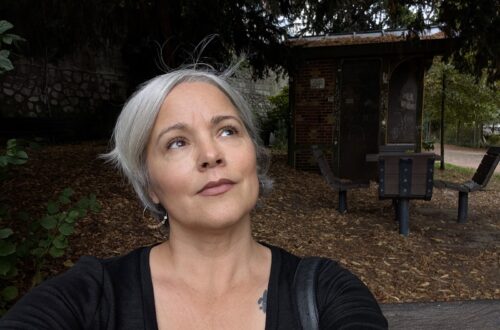

I’ve always been spiritual.
I was raised Roman Catholic in Northern Ontario, and as a child, I ended nearly every day with a prayer to God. But I didn’t only recite the prayers I’d been taught. I would lie quietly and contemplate the nature of God, the meaning of life, and my place within it all.
I also spent hours walking in nature, talking to my understanding of God as though I were speaking with a trusted companion. I didn’t realize it at the time, but many of those childhood prayers, walks, and contemplations were forms of meditation.
They were ways of stepping away from the noise of the world and turning inward toward something sacred.
Finding a Different Spiritual Language
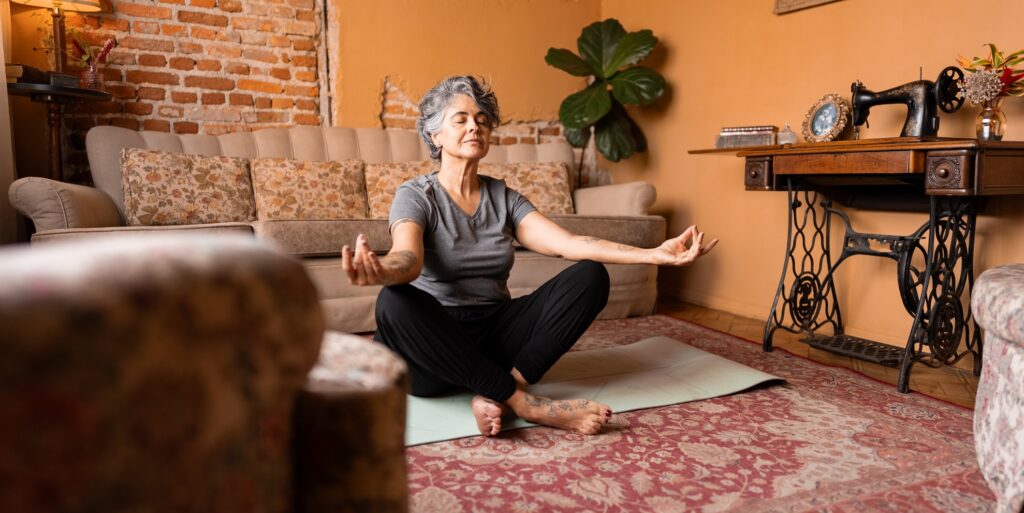
In my twenties, I discovered Eastern philosophies and found a spiritual language that resonated more deeply with me. I learned to meditate in the way most people understand meditation today: sitting quietly, turning my attention inward, and attempting to observe or calm my thoughts.
For a time, I also studied Kundalini Yoga with Sadhguru and the Isha Foundation. I followed practices intended to prepare the body and mind for deeper states of consciousness and the awakening of life-force energy.
Then life intervened, as it tends to do.
Work, relationships, motherhood, responsibility, and the demands of daily survival gradually pulled me away from my spiritual pursuits. I continued to meditate intermittently throughout my thirties and forties, but it wasn’t yet an essential part of my life.
That changed after my Dark Night of the Soul.
When I reached my personal rock bottom nearly seven years ago, meditation became more than a spiritual practice. It became a lifeline.
During one of the lowest moments of that period, I sat in meditation and begged for help. I didn’t know what kind of help I was asking for or where it might come from. I only knew that I couldn’t continue carrying what I’d been carrying alone.
And I was answered.
The response didn’t arrive as an external voice or a dramatic vision. It came as a clear intuitive knowing:
I wouldn’t be allowed to fail.
I belonged in this life.
And I was loved.
That experience became one of the turning points in my healing journey. From then on, I began to meditate more consistently as a way of connecting with LOVE, as I’ve come to know and name the higher consciousness that many of us call God.
Meditation Can Take Many Forms
Over the years, meditation has taken many forms for me. I reject the rigid paradigms that insist meditation must look a certain way in order to count.
I meditate when I write in my gratitude journal. I meditate during early morning walks, when the natural world reveals the endless cycles of birth, death, rest, and renewal. I participate in walking meditations with a group that gathers weekly. I meditate whenever I contemplate something spiritual deeply enough that the outside world begins to fall away.
And each evening at nine o’clock, I sit in my meditation room to recharge my soul and prepare my nervous system for rest.
Some meditations are silent. Some include visualization or energy-clearing exercises. Sometimes I listen to someone else’s guidance and let their voice carry me away from the day. Sometimes I simply sit and allow whatever is happening within me to be there.
All of these practices bring me back into relationship with myself.
They create a space in which I can listen beneath the constant movement of the thinking mind. Nearly every significant intuitive message I’ve received from LOVE—or from the deeper wisdom of my Higher Self—has arrived in that space.

When the Still Mind Finally Arrived
For much of my adult life, I believed the ultimate goal of meditation was to achieve a perfectly still mind.
I’d read about the absence of thought, the dissolution of the ego, and the profound peace supposedly waiting beyond the mind’s chatter. And I gave great effort over the years to reaching that state.
But it always eluded me.
My mind wandered. It planned, worried, remembered, analyzed, and replayed conversations. I’d pull it back, only to watch it race away again. Instead of finding peace, I often found myself wondering whether I was doing meditation incorrectly.
What I didn’t understand then was that I was trying to force myself into a state I wasn’t ready to inhabit.
It’s been nearly seven years since my Dark Night and since I committed myself fully to healing. Through meditation, reflection, writing, forgiveness, and an enormous amount of inner work, I gradually released many of the conflicts I’d been carrying within me.
Then, about two or three years ago, something changed.
One evening, after moving through a series of energy-clearing practices I’d learned from my great teacher, Jeffrey Allen, I sat down to meditate. I wasn’t chasing a particular experience. I wasn’t straining to concentrate or attempting to control my thoughts.
My mind simply seemed to say, “Okay. I’m ready to be quiet now.”
And the thoughts dissolved.
There was no chatter and no effort to suppress it. There was only a deep, blissful stillness.
The experience was so restorative that I had difficulty pulling myself out of the meditation. When I finally opened my eyes, more than an hour had passed.
I’d spent decades trying to make that experience happen, but it didn’t arrive through effort. It arrived through readiness.
The still mind emerged naturally once enough of the conflict beneath the noise had been healed.

Experiences I Wasn’t Seeking
Other experiences also began to arise about that same time during meditation without any conscious pursuit on my part.
At times, the crown of my head would buzz and tingle so intensely that I’d reach up to make sure the top of my head was still there. On other occasions, powerful sensations of bliss and love would erupt from my chest, accompanied by an overwhelming sense of connection and compassion for all living things.
Eventually, I also began to experience a persistent counterclockwise rising sensation within my core. The movement was strong enough to gently move my body whenever I became very still.
Within Eastern spiritual traditions, these sensations might be described as activity in the crown, or Sahasrara, and the heart, or Anahata, chakras. The rising energy might be understood as Kundalini, the life-force energy believed to rest within the body until it’s awakened.
I can’t say with certainty what these experiences are, and I don’t believe anyone else needs to interpret them as I do. I only know how they feel within me and how naturally they emerged.
What struck me most was that years earlier, I’d followed practices specifically intended to awaken Kundalini energy. I’d worked toward something I believed I was supposed to achieve.
Nothing happened.
Later, after years of emotional healing and without consciously seeking an awakening, those experiences arose on their own.
Looking back, I don’t believe those earlier years of practice were wasted. Meditation was already helping me build the awareness, steadiness, and inner safety that healing required. But meditation wasn’t the only path through that healing. Writing, reflection, forgiveness, emotional work, and the slow lessons of lived experience all played their part. What I couldn’t force through spiritual discipline eventually emerged on its own when enough of that deeper work had been done.
Meditation helped me heal, and healing changed the way I was able to meditate. The two weren’t separate stages so much as parts of the same unfolding process.
Coming Back Into the Body
I don’t seek a still-mind experience every time I meditate now.
After a stressful day, simply bringing my awareness back into my body can be enough. We spend so much of our lives mentally somewhere else. We’re replaying a conversation from yesterday, worrying about someone far away, anticipating what might happen tomorrow, or trying to solve a problem that isn’t directly in front of us.
Our bodies may be sitting safely in a quiet room while our minds are still at work, still defending, still preparing, and still running through imagined scenarios.
We live outside ourselves so often that nervous-system overstimulation begins to feel normal.
Meditation brings the mind home.
When our awareness returns to the body, the two are finally able to rest together. We become whole again, if only for a few minutes. Instead of scattering our energy across the past, the future, other people, and situations we can’t control, we gather it back into the place where we actually are.
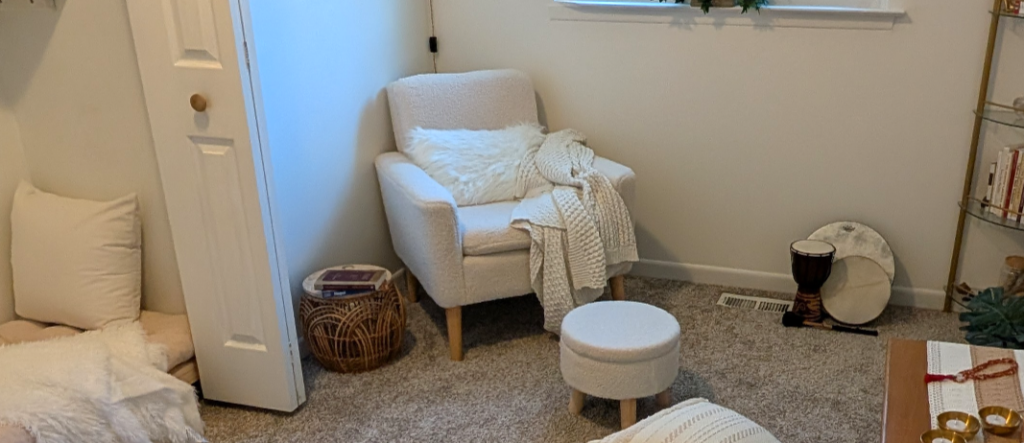
For me, that return sometimes begins with the image of an old easy chair in a cozy room inside my mind.
I imagine coming home after a long day in the outside world. At the door, I drop every piece of emotional baggage I’ve been carrying. I close the door behind me, lower all the shades, and sink into the chair with a deep sigh of relief.
Nothing from the outside world is allowed to enter.
There’s nothing I need to solve, explain, defend, or prepare for. For those few moments, I’m entirely safe within myself.
At other times, I imagine that I’m a deep, dark, still lagoon sheltered beneath a copse of trees. Beyond the lagoon, the river of life rushes and churns, but I’m no longer being carried along by it.
I am the water.
I am still, silent, safe, and alone.
As an introvert whose nervous system is easily affected by too much noise, stimulation, and interaction, these visualizations help me return to equilibrium. They create an internal refuge when the external world has become too loud.
And on evenings when I don’t want to make the effort myself, I listen to a guided meditation and allow someone else to lead me home.
Beginning Without Expectations
So what would I recommend to someone who wants to begin meditating?
First, release your expectations of what meditation should look like.
I spent years worrying that I was doing it wrong, and that worry became another wall between me and the experience I was seeking. I’ve come to believe that many of the walls between us and what we seek are built from expectation, fear, and the belief that we’re somehow doing life incorrectly.
Meditation isn’t a performance, and there’s no spiritual authority watching to see whether you’ve successfully emptied your mind.
Second, make time for it.
Consistency matters far more than perfection. Meditation will change as you change. It may offer comfort during one season, insight during another, and silence when you’re finally ready to receive it. Like trust and surrender, meditation asks us to participate without trying to control exactly how the experience unfolds.
Allow the practice to grow with you.
Third, give meditation whatever form you need on any particular day.
Some days, stillness may come easily. Other days, your mind may be too busy to settle. On those days, you might focus on your breathing, imagine a safe room, walk quietly through nature, write in a journal, or listen to a guided practice.
The goal doesn’t have to be complete mental silence. Sometimes the greatest gift is simply interrupting the momentum that has your mind moving in a million different directions.
Finally, don’t criticize yourself when your mind refuses to cooperate.
Internal criticism creates more inner conflict, which is the opposite of the peace we’re trying to cultivate. If your mind needs to wander for a while, let it wander. Perhaps it’s trying to understand something or work its way through an experience.
Why fight it?
Let there be ease within you.
Even when you sit for fifteen minutes thinking about everything that happened that day, you’re still sitting in a quiet and protected place. You can observe those thoughts without being swept away by them. You can watch the mind move from the perspective of someone who is safe.
That, too, is meditation.

Let the Practice Meet You Where You Are
There’s far more I could say about meditation and how intrinsic it has become to my healing and wellbeing than I can fit into a single post.
Every person’s experience will be different. Not everyone will feel energy moving through the body or enter long periods of thoughtless stillness. Those experiences aren’t the measure of whether meditation is working.
The quieter changes may matter even more.
You may begin reacting differently to situations that once overwhelmed you. You may notice the moment your nervous system becomes activated and learn how to soothe it. You may hear your intuition more clearly or recognize that a thought you’ve been believing isn’t actually true.
You may simply become a safer place for yourself to live.
The effects of meditation often accumulate quietly. Small moments of awareness layer themselves over time, strengthening the foundation beneath you and supporting the other forms of healing your life may ask of you.
You’ll sometimes feel distracted. You may become frustrated. You may believe you’re making no progress at all.
Release the belief that something extraordinary has to happen.
Let the practice be what it is. Let yourself be where you are. Make room for ease instead of creating another struggle within yourself.
Meditation doesn’t ask us to become something we’re not.
It gently invites us to return to the wholeness that has been waiting beneath the noise all along.